
Estate planning is about deciding what happens to your money, property, and responsibilities if you become incapacitated or pass away, but many people put it off because they assume they’re too young. However, if you have significant assets or complex family dynamics, it’s something you should take seriously sooner rather than later. Here’s what you want to understand.
Trusts vs wills
Wills and trusts are both core estate planning tools, but they work in different ways. A will lays out how assets should be distributed after death and can name guardians for minor children. The downside is that probate is sometimes required to validate a will, and the process can be time-consuming, costly, and public depending on the jurisdiction. On the other hand, trusts allow assets to be managed and transferred privately and may offer greater flexibility and control. They can take effect during a person’s lifetime and continue after death, potentially bypassing probate altogether.
Affluent families with multiple properties, businesses, investment portfolios, or valuable collectibles sometimes find that a basic will is inadequate to address the complexity of their estate. For these families, probate can pose significant drawbacks, including public disclosure of wealth, higher legal fees, and an increased risk of disputes or legal challenges. Trusts may help address these concerns by providing privacy, structure, and long-term oversight, but the right estate plan ultimately depends on a person’s assets, goals, and family situation. For many high-net worth individuals, a combination of both is the most effective approach.
Family governance and education
Estate documents alone do not guarantee wealth preservation. Family governance is about the human side of money, values, expectations, communication, and accountability. A family constitution, while not legally binding, can outline a family’s values, decision-making processes, and conflict-resolution rules, and help guide how the family works together to preserve and grow its legacy.
Family governance is especially relevant for:
- Multi-generational family businesses planning succession
- Ultra-high-net-worth families managing significant wealth across descendants
- Families with complex assets including real estate portfolios, trusts, or investments
- Families seeking to implement a philanthropic strategy, aligning charitable giving and impact across generations
Generational education is another core part of family governance, emphasizing importance in talking to your children about wealth, what support looks like, what independence means, and what is expected of them as beneficiaries and future decision-makers. Many families who successfully transfer wealth across generations emphasize education and ongoing communication.
Risk management and wealth preservation
For families with significant assets, estate planning is as much about managing risk as it is about transferring wealth. As net worth grows, exposure to market volatility, inflation, regulatory changes, political uncertainty, and family-related disputes increases. Effective estate plans often address these risks through diversification and coordination, including:
- Holding assets across multiple geographies
- Creating diversified income streams
- Implementing appropriate insurance strategies to support liquidity and continuity
- Avoiding overconcentration in the business, property, or industry that generated the initial wealth
When risk management and diversification are aligned with trusts, tax strategies, and family governance, families can be better positioned to protect their wealth across market cycles and generations.
Estate planning isn’t just for “later”
People often delay estate planning because they associate it with old age or retirement. But estate planning is less about age and more about responsibility. Additionally, estate planning isn’t a one-time task. Life changes, including marriage, children, and career moves, can affect your plan. A financial professional can help you start and navigate your estate planning journey, with routine check-ins and regular reviews to maintain organization, protection, and most importantly, to help ensure your plan evolves as your life does.
Your estate plan should be designed with intention. Contact us today to review strategies that help support your family, values and long-term legacy.
Sources:
https://providentcpas.com/understanding-estate-planning-why-its-essential-for-everyone/
https://smartasset.com/estate-planning/is-probate-required-if-there-is-a-will
https://advisorfinder.com/resources-for-clients/family/constitution-guide
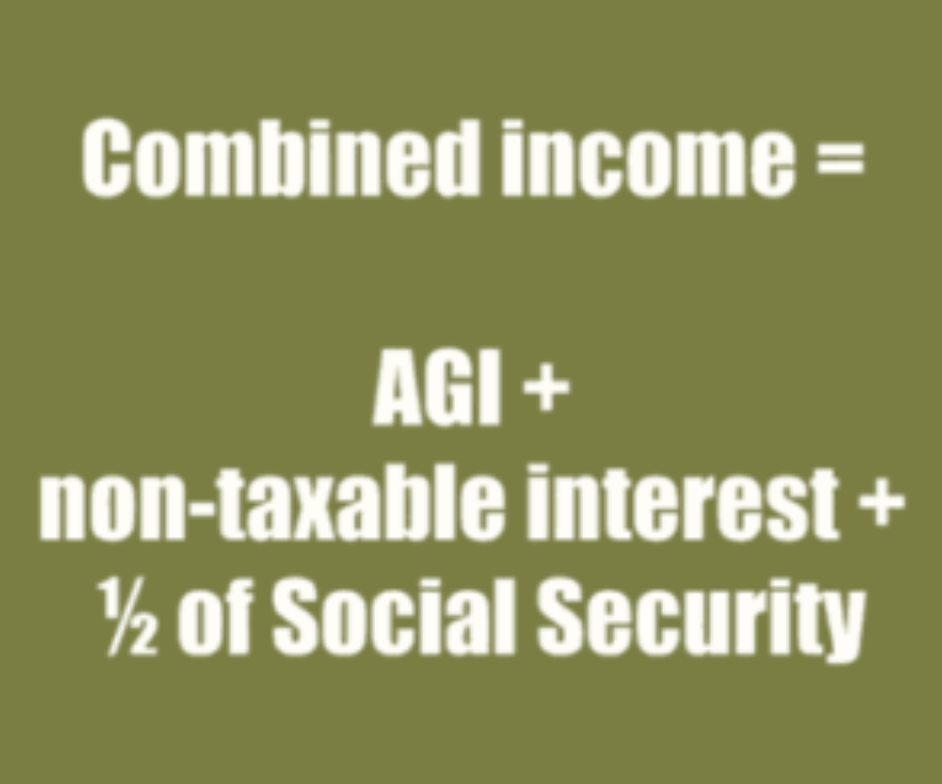
Combined Income is a formula used after you file for your Social Security benefits.
Whether or not your Social Security benefits are taxable depends on your combined income (sometimes called provisional income) each year, which is defined as your adjusted gross income (AGI) plus your tax-exempt interest income (like municipal bonds) plus one-half of your Social Security benefits.
If your combined income exceeds the limit, then up to 85% of your benefit may be taxable. But in accordance with Internal Revenue Service (IRS) rules, you won’t pay federal income tax on any more than 85% of your Social Security benefits.
What are the combined income limits?
Social Security benefits may be taxable if your overall combined income exceeds certain thresholds, which vary depending on your tax filing status.
If you file a federal tax return as an “individual” and your combined income is below $25,000 in 2025, your Social Security won’t be taxed.
For individual filers, if your combined income is between $25,000 and $34,000, you may owe income tax on up to 50% of your Social Security benefits. If your income exceeds $34,000, up to 85% of your benefits may be taxable.
If you file a “joint” return, and you and your spouse have a combined income that is below $32,000 in 2025, your Social Security won’t be taxed.
For couples filing jointly, similar graduated thresholds apply, with those earning between $32,000 to $44,000 owing tax on 50% of their benefits. If their income exceeds $44,000, up to 85% of benefits may be taxable.
These thresholds are periodically adjusted for inflation, so it’s important to check current IRS guidelines or consult a tax professional to determine your specific limits.
RMDs (Required Minimum Distributions) can be an unwelcome surprise.
Starting at age 73 (age 75 in 2033), you are required to start taking money out of your tax-deferred accounts every year, whether you need the income or not. These accounts include:
- Traditional IRAs
- SEP IRAs
- SIMPLE IRAs
- Rollover IRAs
- Traditional non-Roth 401(k) and 403(b) plans
The IRS provides specific tables, such as the Uniform Lifetime Table, to calculate your annual RMD amount based on your account balance and life expectancy. It is crucial to withdraw the required amount by December 31 each year to avoid penalties. Failure to do so can result in a penalty of up to 10% of the amount that should have been withdrawn, and there is no grace period past the deadline.
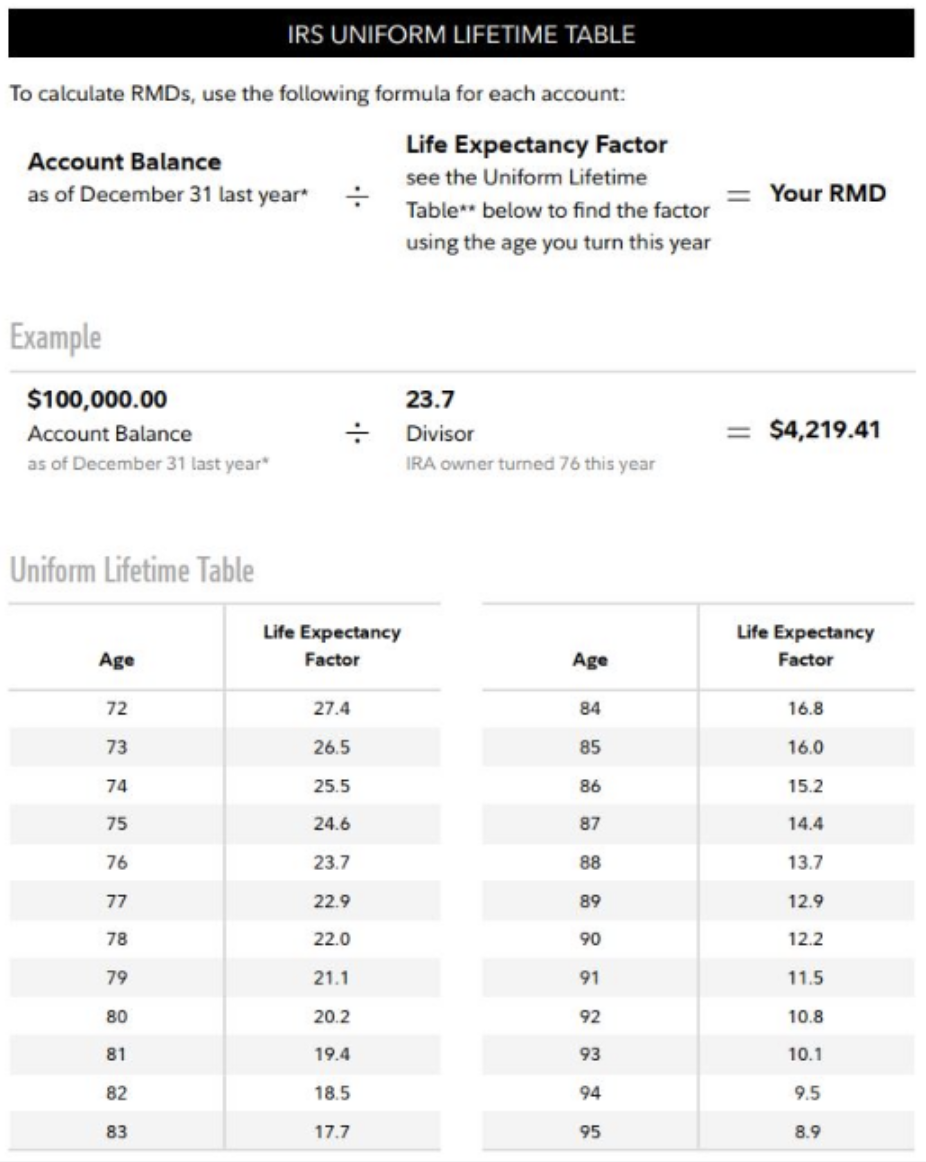
The uniform lifetime table goes up to age 120; learn more here.
Don’t be caught by unexpected taxes. We work in conjunction with your CPA or tax professional to help you consider taxes and how to minimize them as part of your overall retirement plan. Call us.
* This material is not intended to be used, nor can it be used by any taxpayer, for the purpose of avoiding U.S. federal, state or local taxes or penalties. The information in this article is provided for general education purposes only. Do not rely on this information for tax advice. Check with your CPA, attorney or qualified tax advisor for precise information about your specific situation.
Sources:
https://www.ml.com/articles/taxes-and-your-social-security.html
https://smartasset.com/retirement/rmd-table
https://www.fidelity.com/bin-public/060_www_fidelity_com/documents/UniformLifetimeTable.pdf
https://www.fidelity.com/learning-center/personal-finance/is-social-security-taxed